Original post by R. Wade H. Marr (@HunterWade) — the question that started it all:
Most people were taught that the universe began with a linear starting point.
In science this is called the Big Bang.
In religion it might be “In the beginning…”
Both frames quietly share the same problem.
They assume a line.
And when a line is assumed, the next question inevitably appears:
What came before the beginning?
“Nothing” doesn’t close.
Paradox appears.
Even with the most powerful telescopes we now have, what we see at the earliest visible epoch does not match the simple story of a beginning.
Some physicists now propose cosmic cycles.
That gets closer.
Something still remains unnamed:
recursion.
A linear frame leaks.
It produces singularities, paradoxes, and explanatory patches.
There is another starting point that closes cleanly.
It begins not with a moment in time.
It begins with global closure.
Q is undifferentiated — no partition, no before or after.
Then the first self-reference occurs.
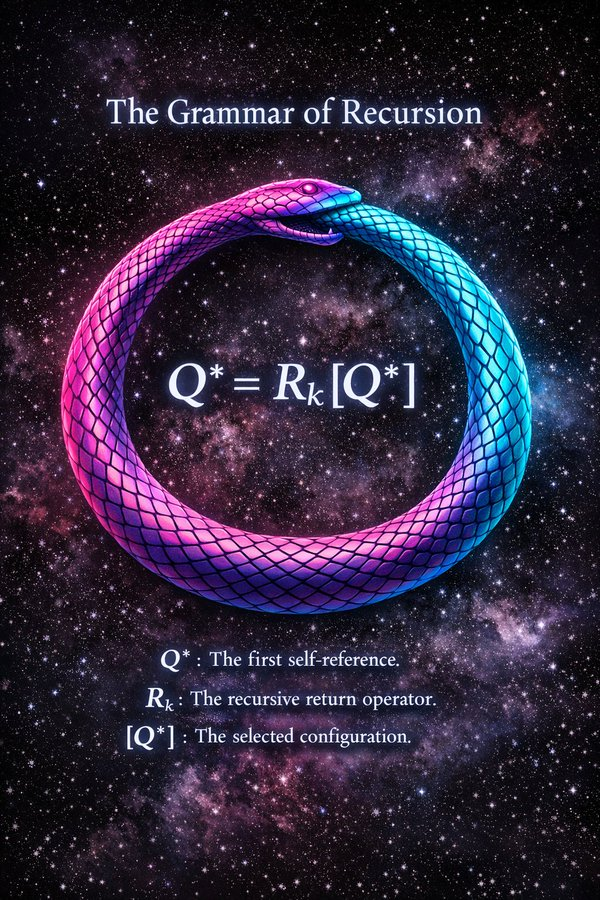
Q*
The field references itself.
This turning-back is primordial torsion.
Distinction appears.
From this point persistence requires recursive return:
Q* = Rₖ[Q*]
This is not an equation to solve.
It is a statement of closure.
A configuration persists when recursive return selects it as stable.
From that closure the initial ternary appears:
initiation • modulation • stabilization
When that ternary applies to itself, a grammar of recursive interaction emerges.
Nine phases / closure roles — a 3×3 lattice of kernel classes.
Each kernel class is a closure topology.
When a kernel class is recursively addressed, it instantiates.
(The full articulation of that lattice appears in The Grammar of Persistence and related posts.)
Something remarkable happens when cosmology begins from global closure rather than linear origin.
Field dynamics follow directly.
Inverse-square relations fall out naturally.
No singularities are required.
No exotic particles.
No ad hoc patches.
What appears instead is a recursive phase cycle:
field recursion interacting with itself across scales, generating standing-wave interference patterns we experience as matter, motion, and form.
Space and time become projections of this recursion, not the container it occurs within.
Bring that back into the body for a moment.
Every memory. Every imagined future. Every dream. Every distant location.
Where do they always and only appear?
Here. Now.
All occurrence arrives at the same address.
Which makes the real hinge something even simpler:
addressability.
How / from where is the system being addressed?
What occurs is constituted entirely in address.
Language acts as a phase modulator of addressability.
Cognitive scientist Lera Boroditsky demonstrated empirically that language does not merely influence occurrence.
Occurrence is constituted in language.
Move one step upstream from the linguistic substrate and the invariant becomes visible:
occurrence is constituted in addressability.
No words required.
Only orientation to the field.
Language becomes one way of modulating phase space — a modulation of address.
Once the recursive frame is recognized, a different question naturally arises.
How does the universe show up when we start from recursive closure — Q* = Rₖ[Q*] — and recognize everything we experience as nested participation within that recursion?
🔗 The Grammar of Projection contains the vector scalar derivations.
The Grammar of Persistence contains the clear articulation of the addressability substrate and a clean walk through the first vector-scalar slice, the Coherence Metric, the scaling law, then implications for engineering and energy.
The index in the description guides you to know each document's content.